General Santos · Philippines
I’m going to General Santos.
A magnitude 7.8 earthquake leveled homes across the southern Philippines on June 8. A week later, tens of thousands of families are still sleeping in the streets, afraid to go back inside. I’m flying in to serve with the Red Cross — and I leave the moment this trip is funded.
Goal: $10,000 · self-funded · I leave as soon as this trip is funded.
What happened
On the morning of June 8, a magnitude 7.8 earthquake struck off the coast of Sarangani.
It hammered General Santos and the towns around it. Buildings came down. Roads cracked. The power went out across whole municipalities. A week on, families are still living outside their broken homes because the aftershocks haven’t stopped. Around 25,000 people are displaced, homes are gone across four regions, and the city’s airport is still closed. The need is immediate, and it’s growing.
The work
I’ll be serving as a temporary volunteer with the Philippine Red Cross, handling two jobs that are really one: logistics and communications — making sure the right help reaches the right people, and that the people doing the helping can actually reach each other.
Relief rarely fails for lack of supplies. It fails in the seams — a truck that leaves half-empty, water that sits in the wrong town for two days, a village no one’s reached because the road to it is buried. My job is to close those seams, and to push help down the last mile to the coastal and island communities that are hardest to reach.
The single biggest problem in this disaster has been communication. With the power down, just getting an honest read on who needs what, and where, has been the hardest part of the whole response. That is the work I’m walking into.
Behind it all sits Davao — the rear base, with the port and the room. Supplies stage there first, then move forward to General Santos and out to the front. I’ll help run that end too: received, sorted, stored, sent.
It isn’t heroic work. It’s mostly clipboards, manifests, and long days. But it’s the work that decides whether a tarp ends up over a child’s head tonight or sits on a pallet for a week.
Who’s going
My name is Kevin Striegle. I’m going alone, and I’m paying my own way there.
I’m not going to the Philippines as a stranger. Years ago, on a yearlong mission called the World Race, I lived and served there — in the red-light district of Angeles City, and on a mountainside outside Manila, running camps for street kids and building whatever needed building. The Philippines already holds a piece of my heart. Now the ground it sits on has been torn open, and I’m going back.
That year carried me through 13 countries — and I ran the logistics for it: getting a squad of 56 people, ages 21 to 35, across the world and back. Visas and customs, border crossings, buses and trains and red-eye flights, lodging, food, and the paper trail of receipts to the home office. Moving people and supplies through chaos to exactly where they need to be is the muscle this trip will ask for.
My mom and sister even flew out and served beside me in the Philippines for a week — so this place isn’t abstract to my family, either.
Where this started
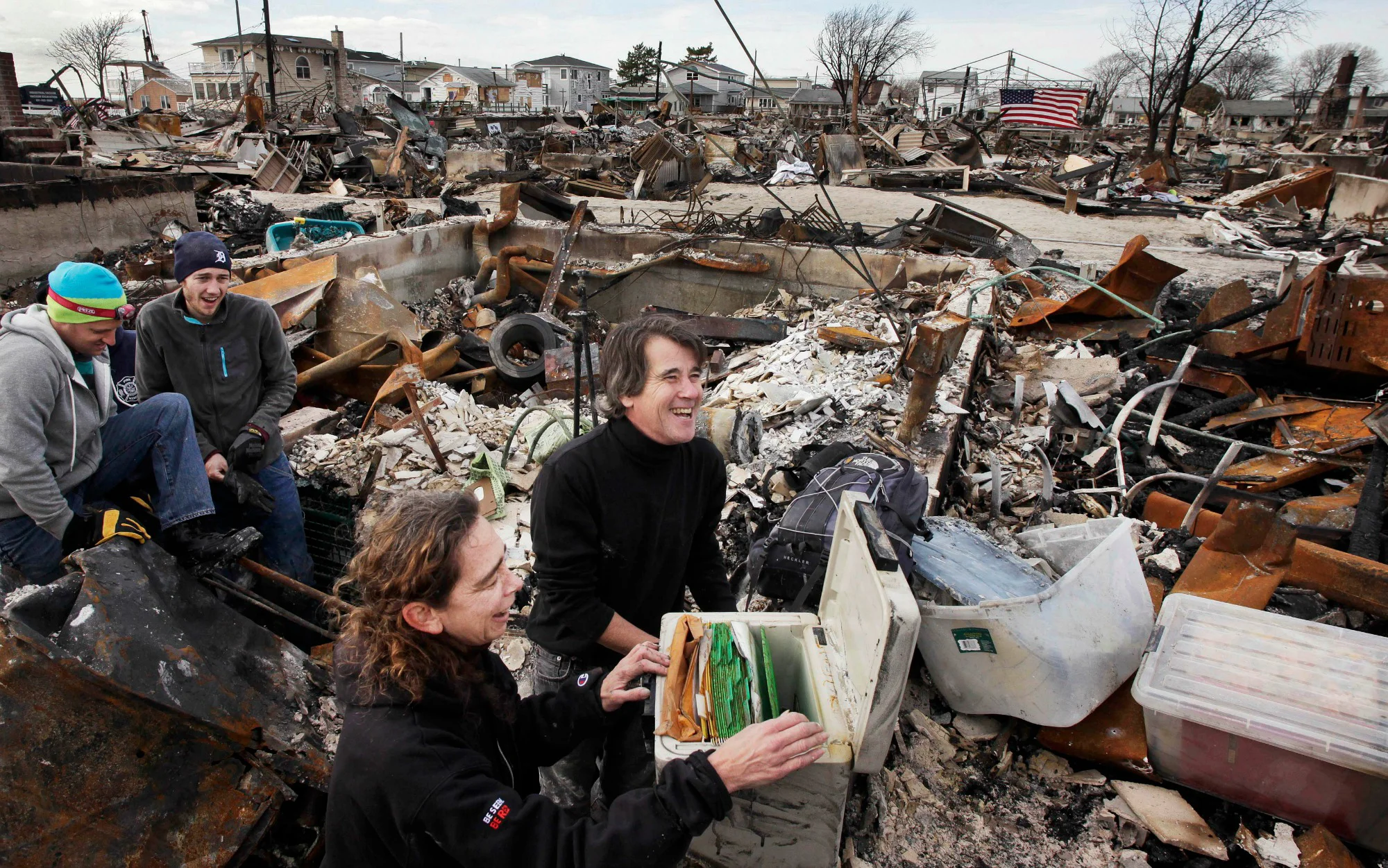
Breezy Point, New York, 2012 — pulling a family’s safe from the rubble after Hurricane Sandy. (Photo: Mark Lennihan / AP)
It started in the rubble. In 2012, after Hurricane Sandy, I spent a week on relief in New York — stacking water by the truckload, gutting flooded homes, and helping a wrecked relief office get the word out so supplies could actually reach people.
On the last day, in Breezy Point, a fire had taken more than a hundred homes. A couple stood in the ashes of theirs, searching for a family safe with their most important papers inside. I climbed down into the debris. Nothing was recognizable — everything burned past knowing. Then I saw a small wooden cross lying in the ash, not touched by the fire. I picked it up, and the safe was right behind it.
We handed it back to them, the papers still inside. I’ve never found a way to explain that moment except the way I saw it. It set the course for everything since — including this.
Where it goes
Two weeks on the ground. Here’s the whole budget, line by line.
About 38% goes directly to aid bought and distributed on the ground. I leave as soon as the full amount is raised. Anything given beyond $10,000 goes straight into the distribution fund. This is a personal mission trip — gifts are not tax-deductible.
Give
If this is yours to be part of, here’s how.
Every dollar accounted for. I’ll bring back the story — photos and an honest report from the ground. Questions? Email kevin@kevtron.com.
I serve as a temporary volunteer with the Philippine Red Cross. This page is my own — it is not affiliated with, endorsed by, or collecting on behalf of the Red Cross.
Walk with me
Not able to give right now? Walk with me anyway. I’ll send updates from the ground — and word of wherever I’m headed next.